
Upcoming solo exhibition 'Melencolia' by Jennifer Allnutt at Beinart Gallery
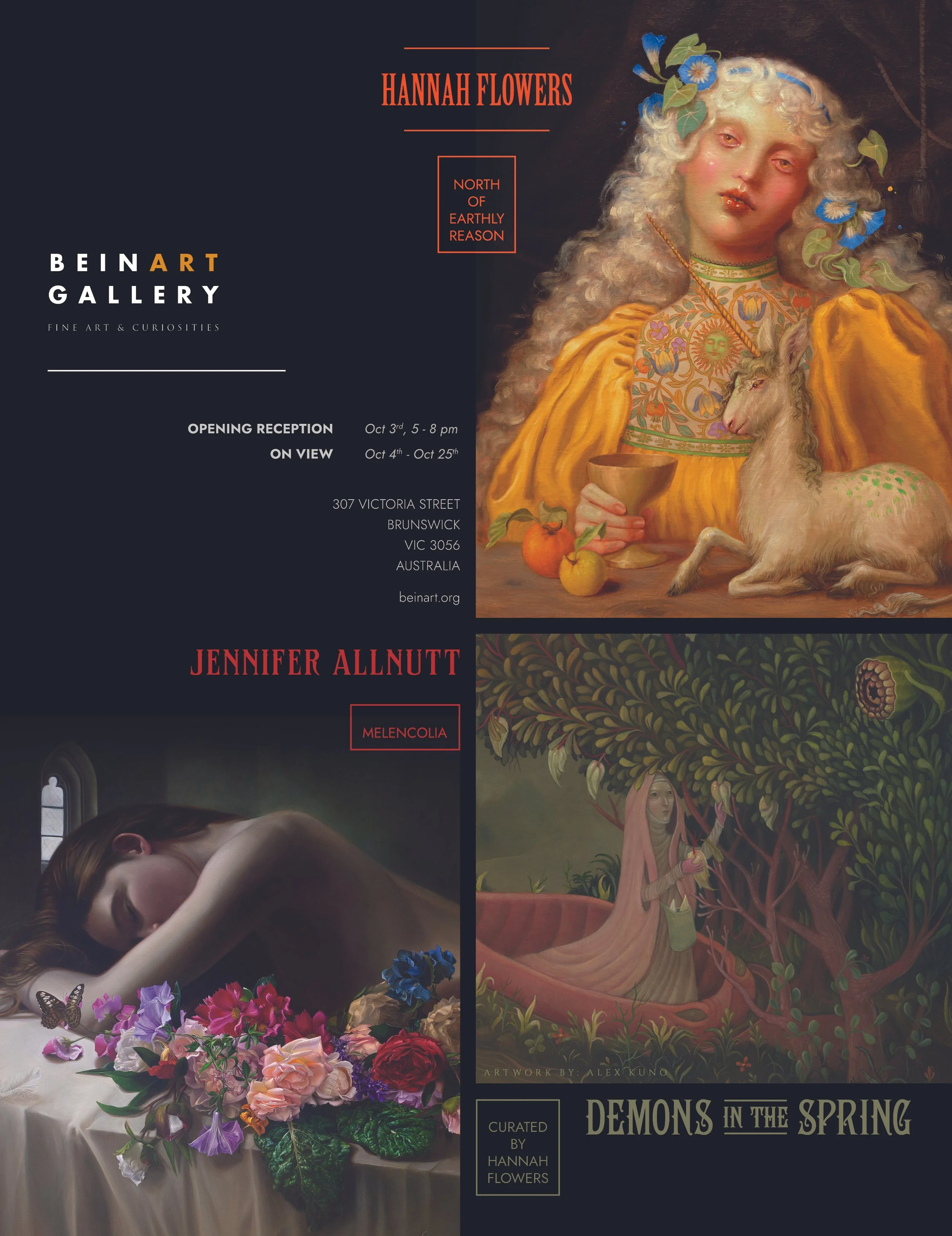
Coming up this October I’m excited to share my next body of work called ‘Melencolia’ which is coinciding with the solo show ‘North of Earthly Reason’ by the delightful Hannah Flowers as well as a fabulous group exhibition ‘Demons in the Spring’ also curated by Flowers. This october at Beinart gallery will be a feast for the senses and I hope you can join us at the opening night Saturday October 3rd 2026.
Melencolia
A solo exhibition by Jennifer Allnutt that began with her admiration for Albrecht Durer’s 16th century engraving ‘Melencolia I’. From that initial spark she delves deeper into the misunderstood yet deeply ubiquitous temperament of melancholy. She explores the necessity of the temperament for creative activity, the fine line between divine inspiration and divine madness, and weeping as a singular cathartic and truly human experience.
North of Earthly Reason
A solo exhibition by Hannah Flowers follows the premise that art can act as a portal to an adjacent headspace, one outside of accepted logic and reason, where the lines between colour, form and music meld, becoming more vital and laden with symbology. Inspired by enduring historical tales of epic journeys she leads viewers along a thrilling and perilous road from the infernos of hell to forgotten isles, alchemists dens and secret gardens. Mythic beasts rise from the mist and both friends and foe are met along the way.
Demons in the Spring
A group show which invites artists to explore a feeling of unease moving through a season of beauty. Here Demons may appear in their most literal forms or linger as more subtle visitations, a shift in mood, a whisper in the undergrowth. Spring unfolds in delicate blooms, choking vines and fleeting plays of light, revealing how beauty and disquiet often grow side by side.
If you’re interested in seeing the shows but unable to attend in person you can sign up to see the online preview here-
https://beinart.org/pages/join-preview-list
Melencolia Press Release:
Read below for an in depth look at some of the inspirations and key texts behind this new collection of paintings.
In Melencolia, Jennifer Allnutt examines melancholy in its many facets. Using Albrecht Dürer’s 16th-century engraving Melencolia I as a point of departure, Allnutt draws on her deep admiration for and curiosity about the work while expanding on her own experiences of melancholy. Through research and painting, she explores a temperament that has been historically misunderstood yet remains deeply ubiquitous.
Join our online preview list for early access to the artworks and pre-sales.
Opening reception: Oct 3rd, 5 - 8pm. This is a free event. As Beinart Gallery is a licensed venue, any minors attending the opening reception will need to be accompanied by a responsible adult.
This exhibition will run from Oct 4th - Oct 25th 2026, and will coincide with Hannah Flowers's North of Earthly Reason, and the group exhibition, Demons in the Spring - Curated by Hannah Flowers.
Paradoxically, Allnutt paints the subject of melancholy to avoid feeling melancholy. She considers the vital relationship between this temperament and creative activity, the fine line between divine inspiration and divine madness, and weeping as a singular, cathartic and truly human experience. Her oil paintings oscillate between exercises in futility and hopeful threshold moments, suggesting that true beauty may be inseparable from a touch of melancholy.
In medieval thought, melancholy was attributed to being born under the sign of Saturn, at a time when health and temperament were believed to be governed by the planets and stars. Melancholy was not merely sadness but was considered a physical illness linked to the ancient Greek theory of the four humours, characterised by an excess of black bile. During the Middle Ages, its understanding shifted further into the religious sphere, where melancholy could be regarded as a vice and, at its extreme, a form of demonic possession.
During the 16th and 17th centuries, however, these ideas began to transform. Rather than simply a malady, melancholy became increasingly intertwined with the creative mind. The Neoplatonist and humanist Marsilio Ficino helped transform what had been regarded as an affliction into a sign of virtuosity, particularly in the arts, and melancholy became associated with those of artistic or intellectual predilection.
Among the key texts informing Allnutt’s new body of work are Robert Burton’s The Anatomy of Melancholy and Alain de Botton’s The Varieties of Melancholy. The poetry and life of Sylvia Plath have been particularly influential. Throughout the paintings are small nods to Plath’s work, notably her novel The Bell Jar and her posthumously published poetry collection Ariel.
Melencolia also extends Allnutt’s broader interests in entomology, botanical illustration, trompe l’oeil and sottobosco, or undergrowth, painting inspired by the Dutch masters. The throughline is a tangible gloom verging on nihilism, yet the works simultaneously offer hope and beauty within the darkness. They propose that perhaps it is the melancholy spirit that can conjure these precious islands of beauty, these glimpses of higher ideals.
Allnutt’s bell jar paintings similarly explore the sensory experience of melancholy, forcing nature and the man-made together as strange bedfellows. Paying tribute to Sylvia Plath, Allnutt uses the imagery of the bell jar to expand upon her own experiences. These transparent sarcophagi are at once suffocating, distorting and disconnecting. Worse still, those contained within remain visible, observed and scrutinised.
Ultimately, Melencolia is a personal cri de coeur, analogous in spirit to Plath but augmented by surrealism, myth and symbolism. Allnutt suggests that the melancholic temperament may be a necessary precursor to reaching greater heights of imagination or truth, and that the resulting works of art might serve as a vital counterweight to a certain kind of madness.
Jennifer Allnutt is an artist based in Brisbane, Australia who works in the tradition of oil painting. She graduated from the University of South Australia with a Bachelor of Visual Arts (First Class Honours) in 2011 and a Master of Teaching in 2016. She’s exhibited around Australia, the US and New Zealand. Allnutt was a finalist and third prize winner (Beautiful Bizarre Art Prize 2024/2025) and the winner of the Lethbridge Small Scale Art Award (2024). Allnutt’s work is best characterised by dark romanticism and her blending of figurative surrealism with picturesque florals that evoke a Northern Renaissance sensibility.